27 November 2012
TRAIL CALL NO 3
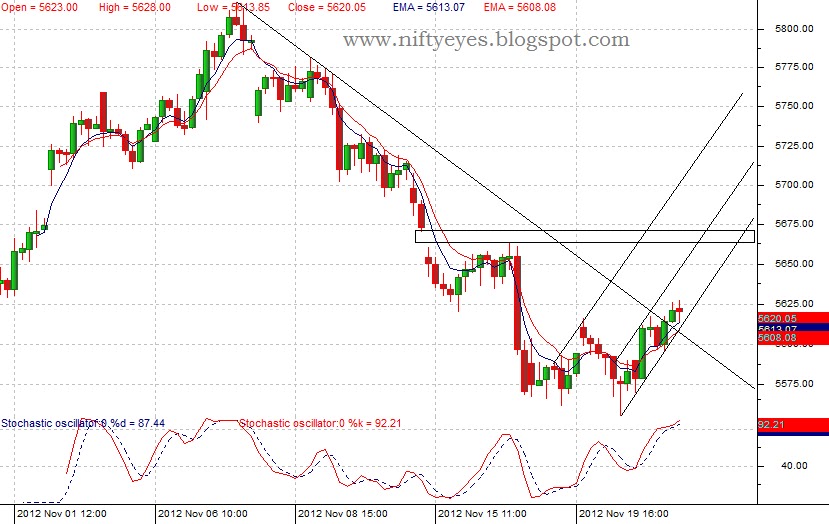
NIFTY X- RAY REPORT FOR 27 NOV
IMPLIED VOLATILITY
Most of traders ignore the implied volatility in trading but this is very useful tools. Implied volatility (IV) is the most useful mathematical tools in stock market of the option greeks. Implied volatility can be used to adjust your risk control and trigger trades.
Implied volatility changes as investor sentiment changes in the market and can be very sensitive to the overall market environment. It can forecast the market direction and make trading decisions.
Implied volatility as measure of relative value
The implied volatility of an option is a more useful measure of the option's relative value than its price. The reason is that the price of an option depends most directly on the price of its underlying asset. Implied volatility is so important that options are often quoted in terms of volatility rather than price, particularly between professional traders. In short in a single and simple line i would like to say that Implied volatility is simply a amount the stock price will fluctuate either side.
Example
A call option is trading at Rs.1.50 with the underlying trading at 78.05. The implied volatility of the option is determined to be 18.0%. After few days, the option price is trading at 2.10 with the underlying at Rs.79.5., yielding an implied volatility of 17.2%. It means that the price option of the call of underlying may fall and rise 17.2%. Even though the option's price is higher at the second measurement, it is still considered cheaper based on volatility. The reason is that the underlying needed to hedge the call option can be sold for a higher price.
Implied volatility reflects what traders “thinking” about the potential for the underlying stock or index.
Implied volatility will rise when traders are becoming very fearful. Same implied volatility will fall when investors are very bullish. This matters to option traders because an increase in implied volatility causes a rise in option premiums. But that is bad for option buyers but can be good for sellers. When implied volatility is falling and traders are becoming more bullish, option prices fall and being a call buyer may be a better alternative than being a put seller.
Implied volatility is a dynamic figure that changes based on activity in the options marketplace. Usually, when implied volatility increases, the price of options will increase as well, assuming all other things remain constant. So when implied volatility increases after a trade has been placed, it’s good for the option owner and bad for the option seller.
Same if implied volatility decreases after your trade is placed, the price of options usually decreases. That’s good if you’re an option seller and bad if you’re an option owner.
For example, imagine stock XYZ is trading at Rs.70, and the implied volatility of an option contract is 15%. This implies there is a consensus in the market that a one standard deviation move will be happen either side plus or minus 10 (since of the Rs.70 stock price equals Rs.10).
Traders thinks that there’s a 68% chance that XYZ will be settle between Rs.60 and Rs 80.
26 November 2012
CLOSING UPDATE
NIFTY X-RAY REPORT FOR 26 NOV 2012
25 November 2012
HIDDEN SECRETS
23 November 2012
INTRADAY ACTIVITY
21 November 2012
NIFTY X- RAY REPORT FOR 22 NOV
20 November 2012
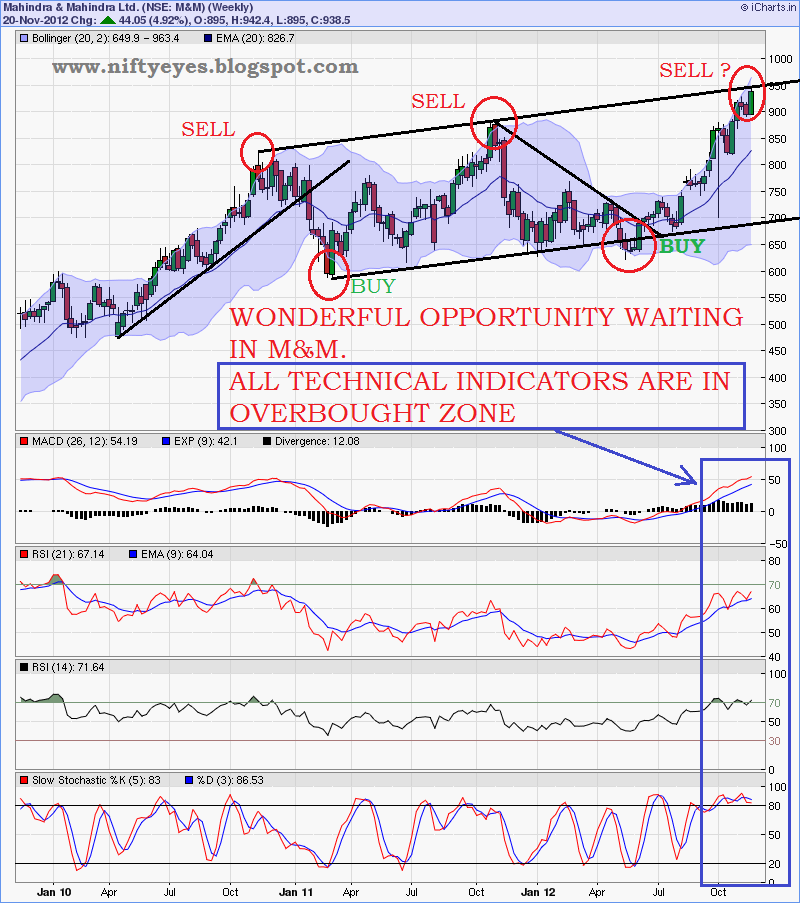
WONDERFUL OPPORTUNITY WAITING IN M&M
THERE ARE WONDERFUL OPPORTUNITY WAITING IN M&M. AS PER ABOVE CHART THE STOCK HAS ZOOM TO 3.27% TODAY AND 4.9% IN TWO DAYS AND TOUCHED LONG TERM WEEKLY CHANNEL. ALL TECHNICAL INDICATORS ARE PLACED IN OVERSOLD ZONE ON BOTH DAILY AND WEEKLY CHARTS.
NIFTY X-RAY REPORT FOR 21 NOV
19 November 2012
NIFTY X- RAY REPORT FOR 20 NOV
18 November 2012
AURBINDO PHARMA
NIFTY X-RAY REPORT FOR 19 NOV
HOW DO YOU CHOOSE A BROKER
Finding the right stockbroker will make your trading experience more efficient and profitable. There are several different types of brokers and financial advisers that will work with you.
All brokers will execute trades for their clients, but a good broker will also research on various investments in stock market and provide advice to you. A good broker really consider your portfolio. Ideally, a good broker thoroughly researches various investments and keeps you up-to-date with market trends and with the stock performance. Did you consider this ever before signing the application form.
In return for these services, the broker charges fees when you buy or sell stocks. For example, you buy 100 quantity stocks and you pay brokerage rs 100. A broker also typically charge annual service charges or maintenance fees for your account. Most disturbing, because all brokers receive commissions every time for executing a trade for the client, their compensation is largely determined by how many times you buy and sell stocks in your account. This is not to say that you shouldn't use a broker, but if you do, go into it with your eyes wide open, thoroughly check the broker out. Does your broker charging very high commission for executing trade. For example, if you buy 100 quantity of a perticular stocks which price is at 100 and the broker charge rs 100 for executing order. Same order can be execute at rs 20-30 only. which broker would you like to choose. choice is yours. Does your broker provide you technical analysis training and various research on stocks and on stock Market, because they are charging annuals fees and commissions on your every buy and sells. If not then you are only the source of profit for them, but they are not for you.
Nifty Eyes provide all technical training for their clients absolutly free and charges very low brokerages. yes we charge Rs 20 only per trade order, quantity no matter.
Open an account with Us and learn free tecnical analysis training and get various research on market and stocks. We are associate partner with Zerodha! Zerodha is an online discount brokerage firm. Through us you can buy and sell Stocks, Futures & Options, Commodities, and Currencies using cutting-edge software at unbelievably low costs. Zerodha charges a fee of only 0.01% or a maximum Rs. 20 per executed order irrespective of the size of the order.
Disclamer:-
Futures and Options trading have large potential rewards, but also large potential risk. You must be aware of the risks and be willing to accept them in order to invest in the Futures and Options markets. Don't trade with money that you can't afford to lose. This is neither a solicitation nor an offer to Buy/Sell Futures or Options.
The contents of this site are for general information purposes, only. The strategies/plan discussed above in this thread/site is made by me based on data which is operated and maintained by third parties. However it is tested and proved every attempt has been made to assure accuracy, but it is by me only. We assume no responsibility for errors or omissions. Examples on this site and in the manual are provided for illustrative purposes and should not be construed as investment advice or strategy. The future data manual is for informational purposes only. These predictions/tips are technical , based on charts conditions ONLY. This is only a guideline, the decision has to be taken after logical thinking by you. Technical analyst and astrologist will not be liable for any personal or financial losses or profits.
The information and views in this website & all the services we provide are believed to be reliable, but we do not accept any responsibility (or liability) for errors of fact or opinion. Users have the right to choose the product/s that suits them the most.